Endoscopic Navigation-Based Tumor Excision: Advanced Minimally Invasive Brain Tumor Surgery
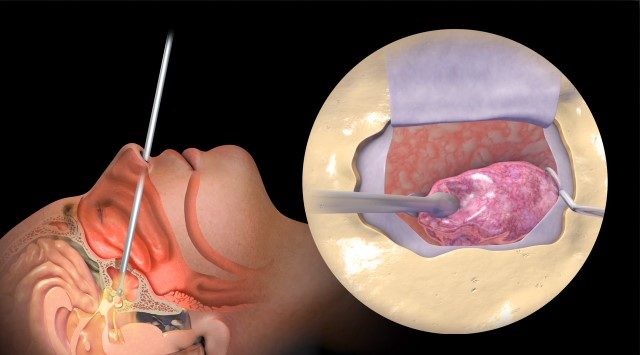
Endoscopic Navigation-Based Tumor Excision is a highly advanced neurosurgical procedure used to remove brain tumors with maximum precision and minimal invasion. It combines endoscopic (camera-based) surgery with computer-assisted navigation systems to accurately locate and remove tumors.
This approach allows surgeons to access deep or complex areas of the brain through small openings, reducing damage to surrounding healthy tissue.
How Does This Technology Work?
This procedure integrates two advanced technologies:
1. Endoscopy
A thin, flexible tube with a camera (endoscope) is inserted
through a small incision,
providing a clear and magnified view of the surgical area.
2. Navigation System
Preoperative MRI or CT scans are used to create a 3D
map of the brain, guiding the surgeon in
real time—similar to a GPS system.
Together, these technologies ensure precise tumor removal with enhanced safety.
When is This Procedure Recommended?
Endoscopic Navigation-Based Tumor Excision is recommended in cases where:
- Tumors are located deep within the brain
- Tumors are near critical brain structures
- Minimally invasive approach is preferred
- Conventional surgery carries higher risk
- Precise tumor removal is essential
Types of Brain Tumors Treated
This advanced technique is effective for:
- Pituitary tumors
- Brain cysts
- Ventricular tumors
- Selected gliomas and meningiomas
- Skull base tumors
Benefits of Endoscopic Navigation-Based Surgery
- Minimally invasive (small incision)
- High precision and accuracy
- Better visualization of tumor
- Reduced damage to healthy brain tissue
- Less pain and faster recovery
- Shorter hospital stay
- Lower risk of complications
Procedure Overview
- Detailed MRI/CT scan is performed
- Images are integrated into the navigation system
- Small incision or natural pathway (like nasal route) is used
- Endoscope is inserted for visualization
- Navigation guides precise tumor removal
- Continuous monitoring ensures safety
Recovery After Surgery
- Short hospital stay (typically a few days)
- Faster recovery compared to open surgery
- Gradual return to daily activities
- Follow-up imaging to monitor results
Risks and Complications
Although safer than traditional surgery, possible risks include:
- Bleeding
- Infection
- Brain swelling
- Neurological deficits (rare)
- Incomplete tumor removal in complex cases
Who is the Ideal Candidate?
You may be a suitable candidate if:
- You have a brain tumor in a difficult-to-reach location
- You prefer a minimally invasive approach
- Your condition requires high surgical precision
- You are medically fit for neurosurgery

Dr. Rahul Sharma
MBBS, MS, DNB (Neurosurgery), FIPP, FESS (Germany)
Senior Consultant Neurosurgery & Chief – MISS & Pain Modulation